The Dot Comm Boom!

Tom Roderick

Thomas Roderick

Portfolio Manager

Tom Roderick

Thomas Roderick

Portfolio Manager
Thomas began his career in hedge funds at the start of the global financial crisis, before managing a macro portfolio at Eclectica under Hugh Hendry. Thomas manages a discretionary global macro strategy for Trium. The strategy follows a traditional thematic approach to macro investing, with a focus on identifying and monetising major macroeconomic and geopolitical trends. Tom invests across fixed income, FX, commodities and equities, with a global remit encompassing both developed and liquid emerging markets. Thomas holds an MSci Physics from Imperial College, London.
Trium Epynt Macro
Trium Epynt Macro

Latest Insights

Share on

A series of linked macro drivers has breathed new life into commodity markets. While the COVID crisis is over and the Russian war is now static, the upending of the geopolitical order continues to drive prices.

Three key factors have pushed up prices of (certain) commodities:

  1. Capex has surged in the West to reindustrialise, greenify electricity, and deal with the increased power demand to fuel the AI frenzy
  2. Tariffs (whether actual or feared) have led to hoarding, bifurcated markets and supply and demand mismatches
  3. Decoupling has provoked a shift away from financial assets towards real assets


The first factor means prices generally need to move higher and is well understood. The last two geopolitical drivers add convexity and volatility, leading to an excellent trading environment. 

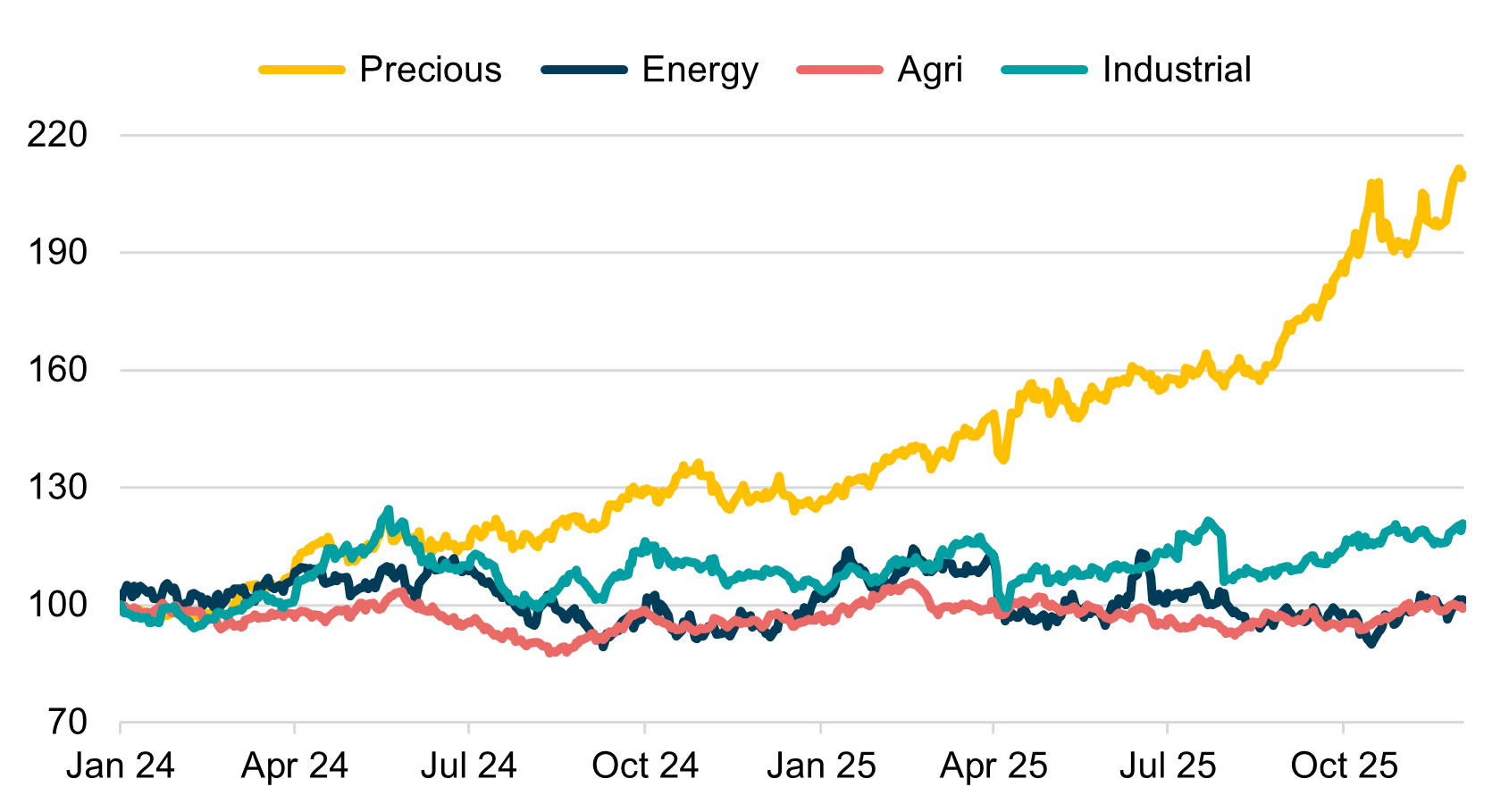
This is a very different type of environment from that of the early 2000s, where the price of almost every commodity surged. This time, gold has rallied first, and we think industrial metals may be next.

Exhibit 1: Commodity Subsector Returns

Source: Bloomberg & Trium Capital.

Gold - Price higher due to Western sanctions

The doubling of the gold price has been THE big macro trend of the last two years.

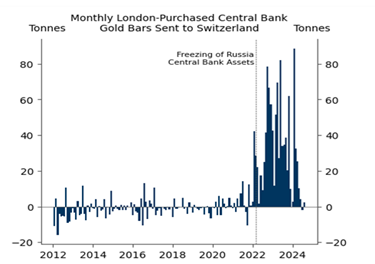
Back in June 2024, we wrote about how the bid for gold has shifted from Western investment flows to central bank accumulation. The rally has not been driven by the threat of tariffs on gold itself (although there was a brief scare), but rather the desire of non-US-aligned countries to mitigate confiscation risk. 

Exhibit 2: Gold accumulation by central banks has dramatically increased post Russia’s invasion of Ukraine

Source: Goldman Sachs International.

China has been a major buyer (both through official channels and “off-the-books” purchases by related institutions) as it seeks to stash its significant trade surplus in assets outside of US financial system influence. 

The rally has cooled of late, with a sharp sell-off in October, but the conditions for further appreciation remain very much in place. Even with a comprehensive US-China trade détente (which we don’t have), the trend of accumulation likely continues

Gold is a ‘Veblen good’: The higher the price goes, the more desirable it becomes. Increased central demand thus drives new flows into ETFs rather than encouraging profit taking.

Silver - Mere threat of tariffs has squeezed prices

Gold’s rally has pulled up other stores of value like silver.

There is also an industrial angle to silver, given its superior electrical conductivity, and the metal benefits from massive demand from Chinese solar panel production.

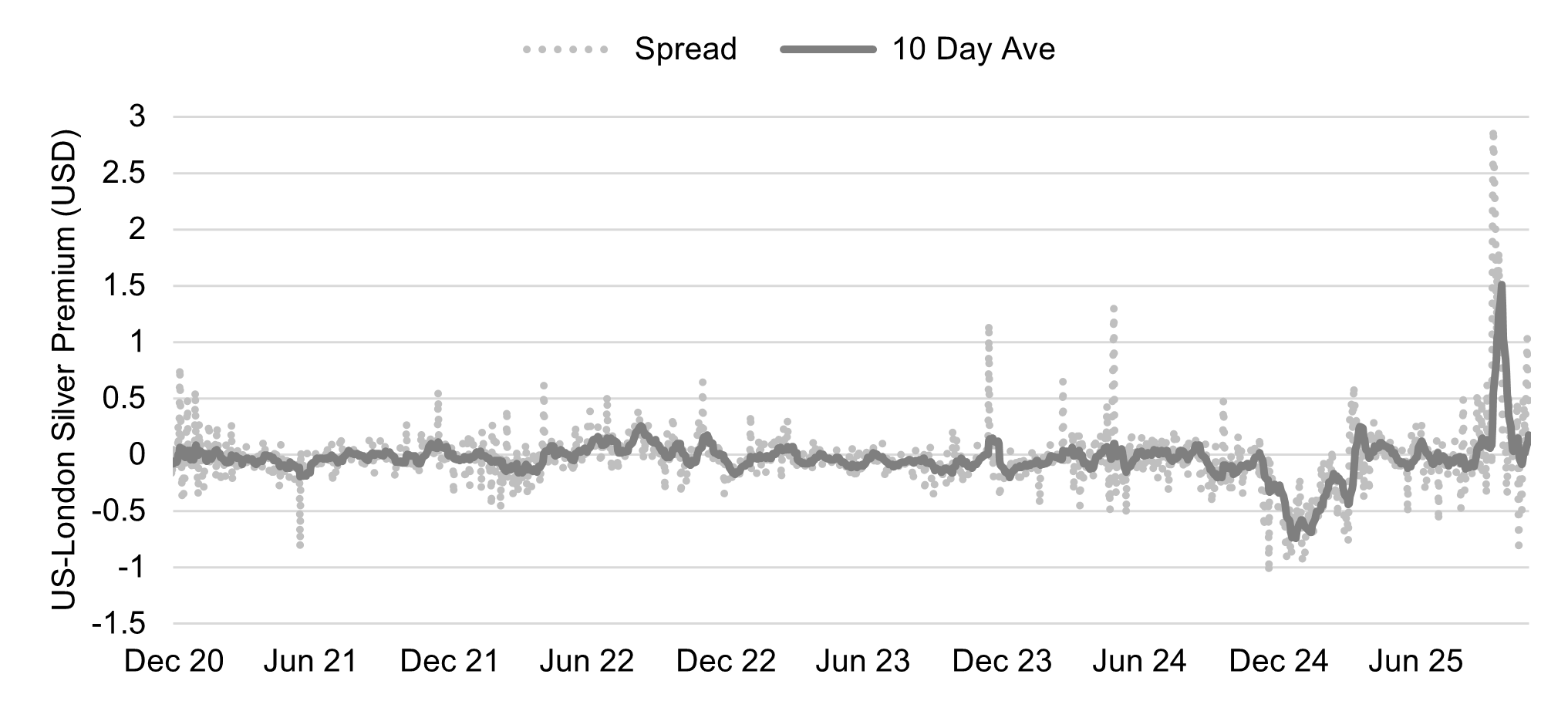
Tariffs (or the threat thereof) have been playing a big role in recent price dynamics, with the ongoing prospect of US tariffs causing US and London silver prices to decouple by the largest margin in history.

Exhibit 3: US silver has been trading at a record premium to London

Source: Bloomberg & Trium Capital.

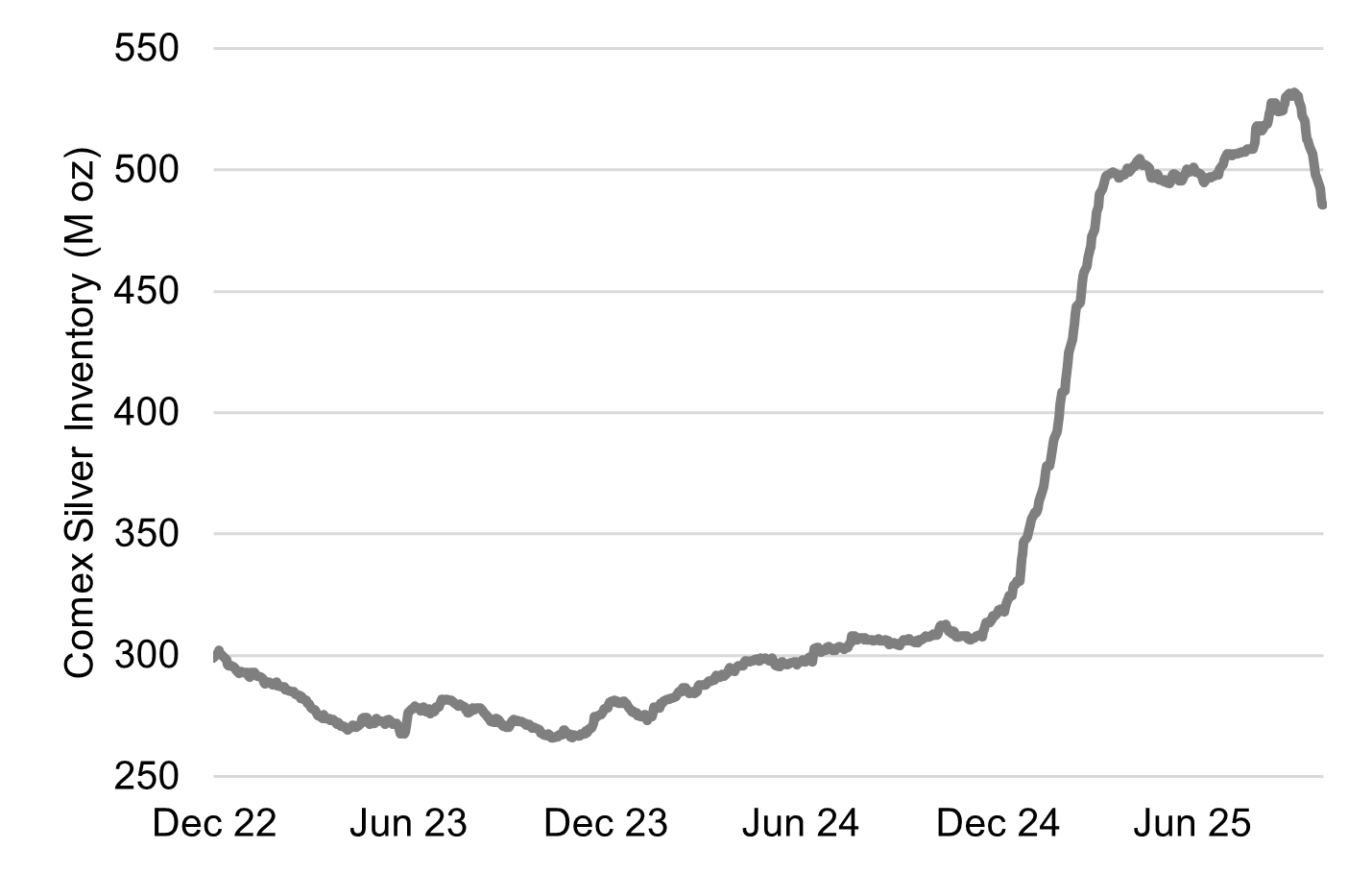
Where incentives point, material follows. The market shifted a substantial quantity of silver into the US on fears of impending tariffs. 

Exhibit 4: Since Trump’s re-election, US silver stocks have increased 60% YoY

Source: Bloomberg & Trium Capital.

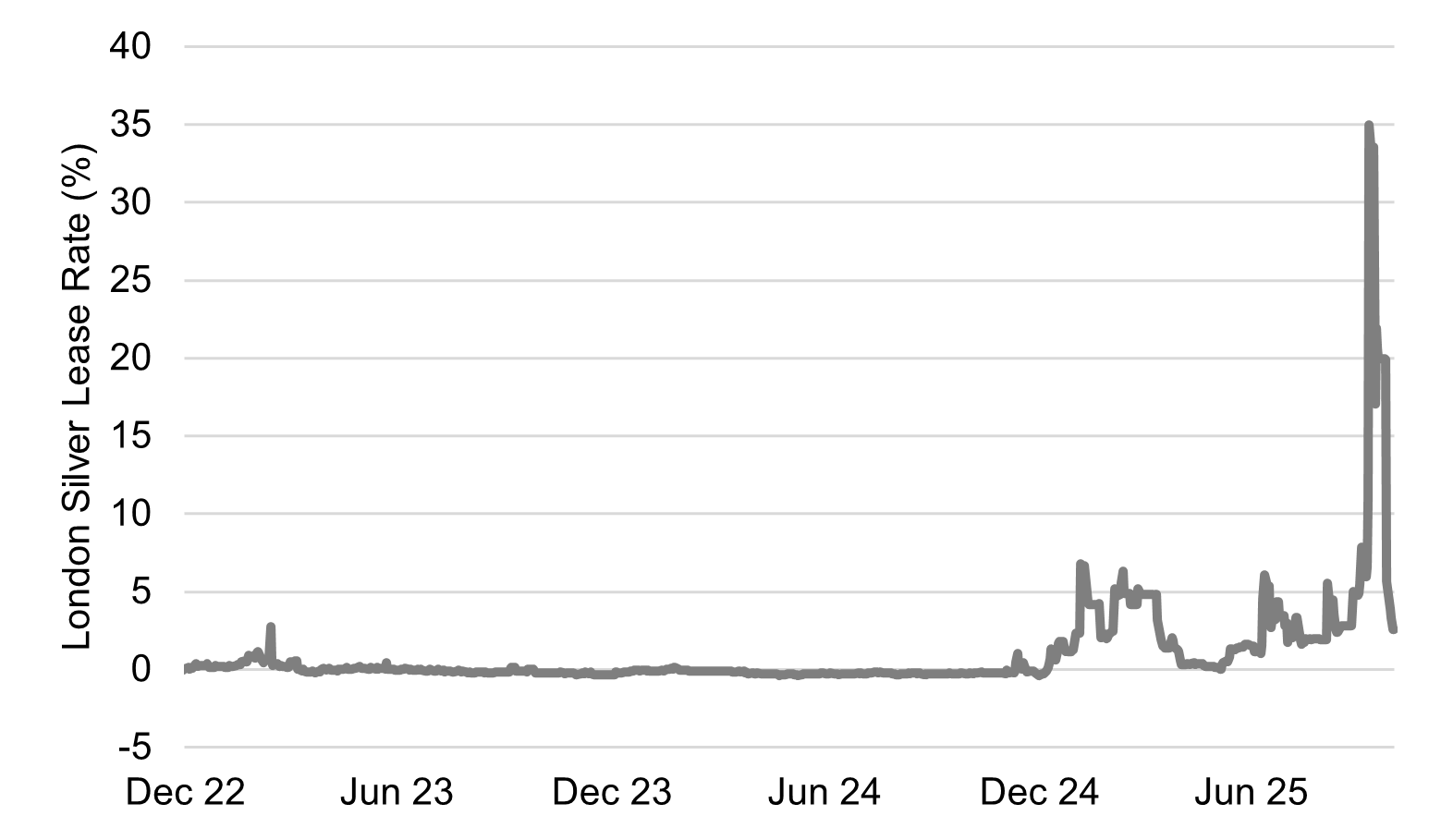
Exhibit 5: Shortages see cost of borrowing silver in London surge to 30%

Source: Bloomberg & Trium Capital.

This time, tariffs were not imposed, but the risk of another squeeze higher remains high with silver on the US administration’s list of critical minerals under threat of tariffs. 

Copper - Tariffs gone but not forgotten

Copper looks to be next, offering another highly compelling long-term narrative, amid huge demand for electrification, albeit navigation of the short term can be treacherous!

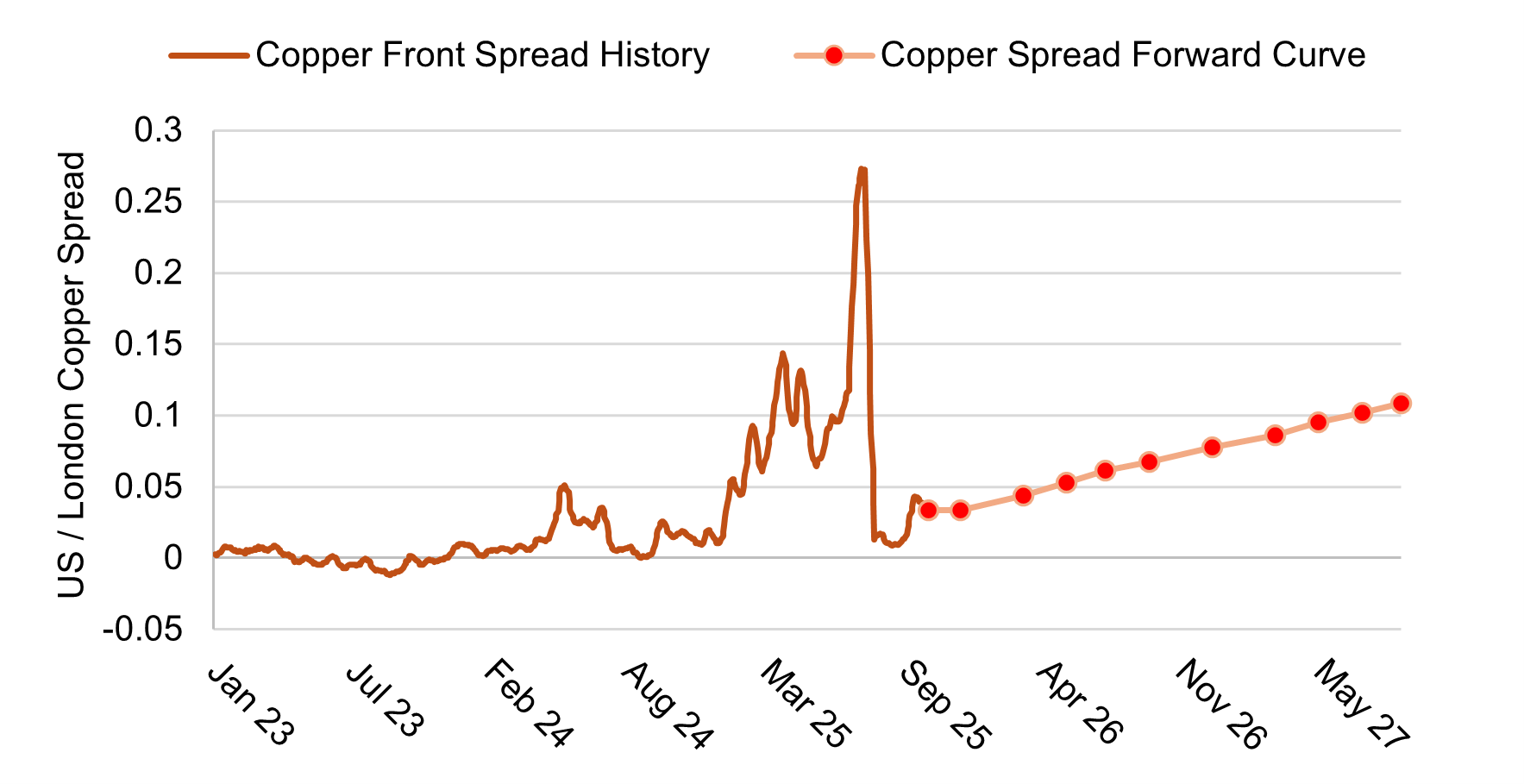
Speculation surrounding copper tariffs has led to major price volatility this year. Trump imposed 50% tariffs on imports in July, causing US copper (inside the tariff wall) to trade up to a 30% premium to London copper, before an extensive list of exemptions saw prices crash back down.

Market participants have a strong incentive to hoard copper in the US, however, with the likely implementation of 15% tariffs by January 2027 (rising to 30% by January 2028).

Exhibit 6: US copper offers a 6.5% annualised return relative to storing it elsewhere

Source: Bloomberg & Trium Capital.

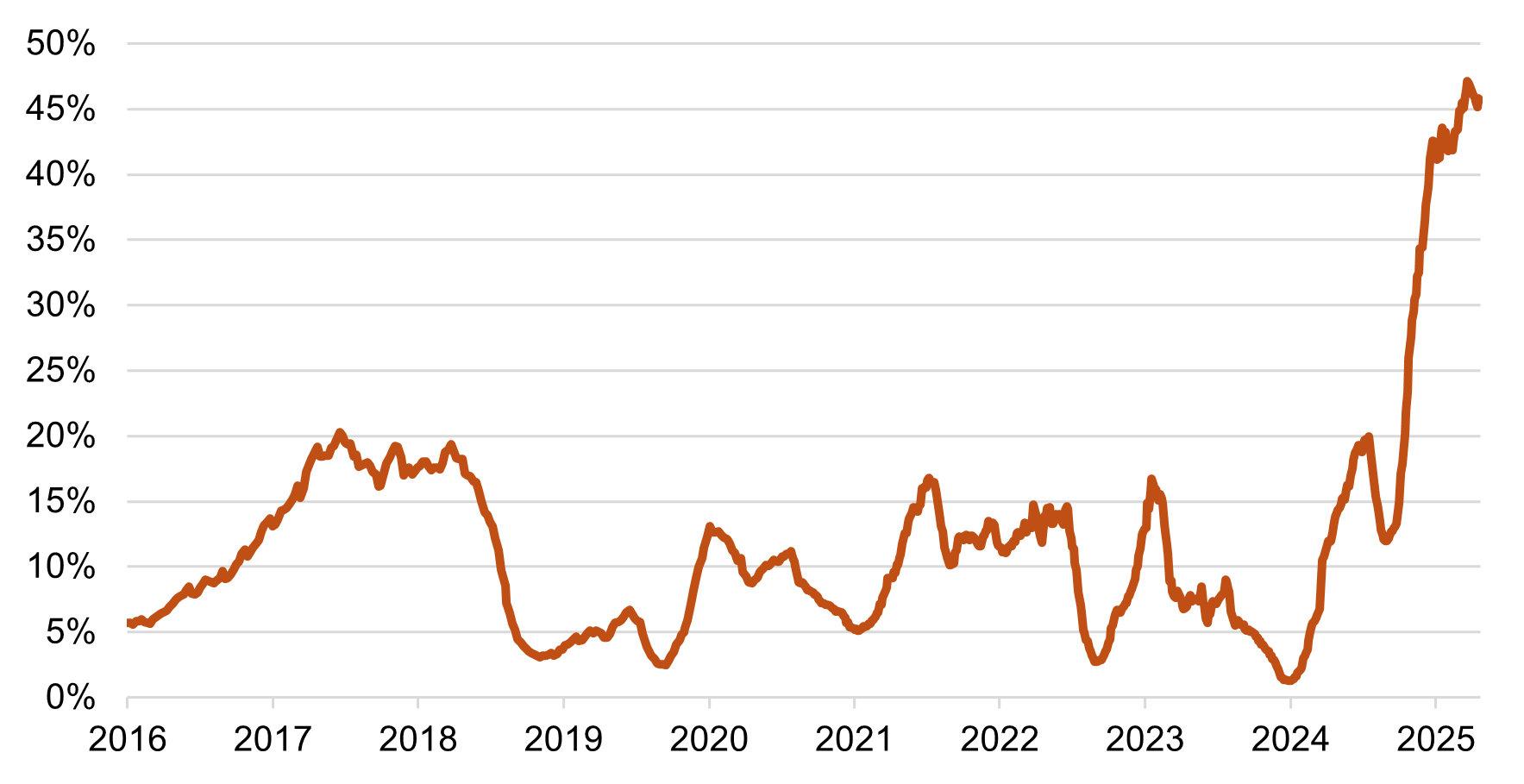
Whether or not tariffs come back again, storing material in the US is a no-brainer. This tightens the already tight global copper market by pulling in more material than is needed into the US.

Exhibit 7: Proportion of global copper inventory held in US

Source: Bloomberg & Trium Capital.

Rare Earth Metals - Chinese reactionary decoupling

At just $10bn, the rare earths market is tiny. But it is critical, with a quarter of global manufacturing output dependant on it in some form.

Despite the name, rare earths are not rare. But extraction and processing/refinement are highly concentrated.

It is a filthy business which strategic, state-driven initiatives have enabled China to corner. Rare earths hit the headlines in 2025 as the Chinese used their controlling position to impose export controls to gain leverage in trade negotiations. The move came in response to the US cutting chip access to slow China’s AI progress.

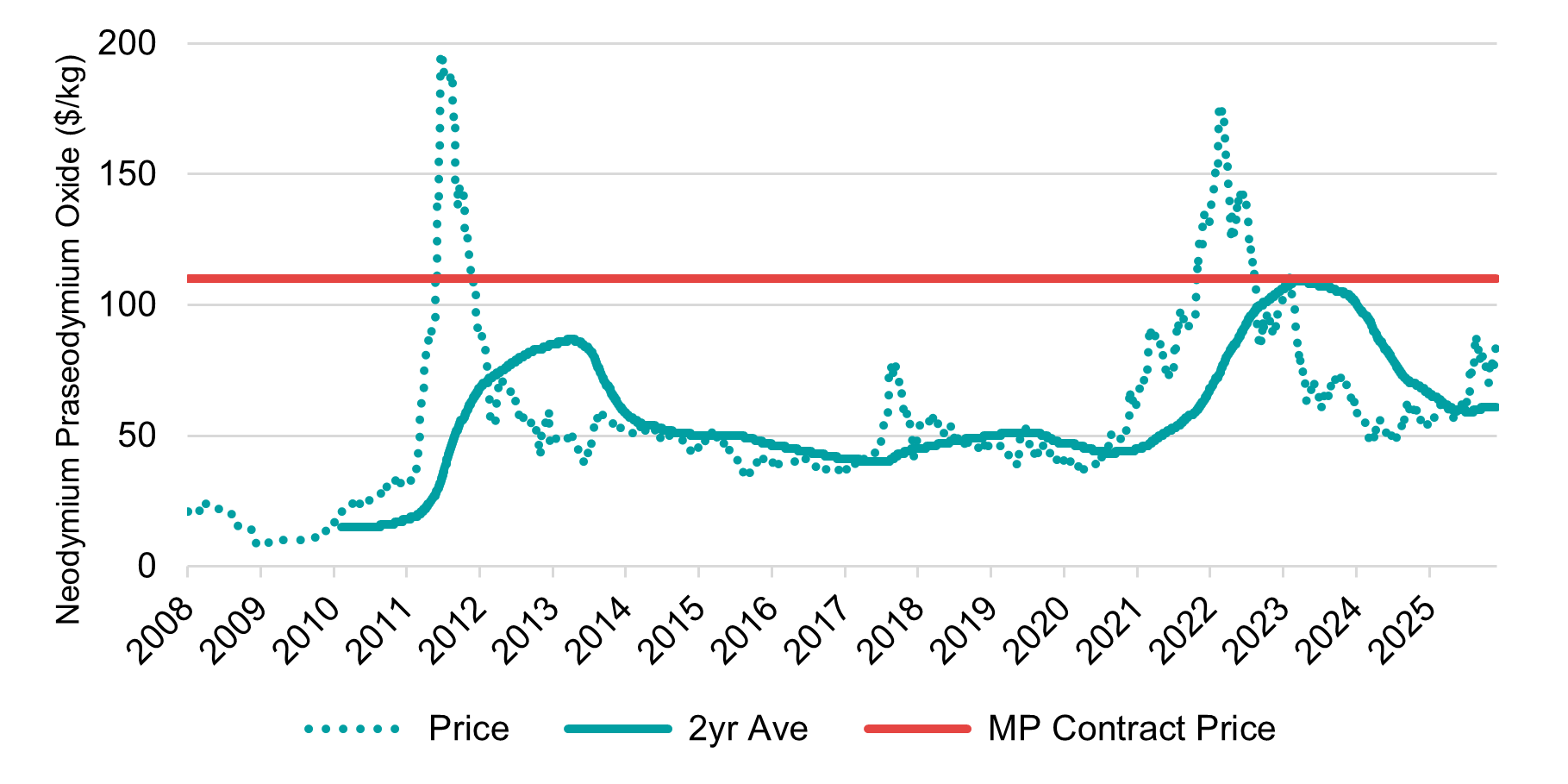
Security of supply has now become more important than price. Western supply chains are completely decoupling from China, with manufacturers paying up for non-Chinese sources. Highlighting rare earths’ critical role in military technology, the Department of Defense signed a contract with US-based MP Materials for the supply of the key Neodymium Praseodymium Oxide compound at a price floor of $110 per kg – a whopping 81% above the global two-year average price.

The case illustrates how small parts of a very complicated supply chain can have a huge impact. The US and others are highly incentivised to solve the problem and decouple their economies from the threat, which means higher prices.

Exhibit 8: Neodymium Praseodymium Oxide prices versus deals being signed

Source: Bloomberg & Trium Capital.

Summary

The longer-term bull case for commodities rests on the powerful macro forces of decarbonisation and deglobalisation, pointing towards significantly higher prices. Less well understood is the impact of sanctions and tariffs. They have injected huge volatility into markets and opened a massive opportunity for active trading.

RELATED INSIGHTS

SIGN UP TO TRIUM TALKS
Trium Talks triangle