The JGB Confidence Game: Why Sovereignty Still Rules

Anton Tonev

Anton Tonev

Strategist

Anton Tonev

Anton Tonev

Strategist
Anton joined Trium Capital in February 2023 to be the third member of the Trium Larissa Global Macro Strategy’s Portfolio Management & Research team. Anton’s previous experience includes being Head of Thematic Research for HSBC where his roles included being Head of Global Macro for HSBC Multi-Asset Trading Desk in London. Prior to that Anton was a Portfolio Manager and Thematic Researcher for Moore Capital, which followed 7 years at Morgan Stanley, where he worked as a Trader alongside Peter Kisler for a period . Anton brings additional research and idea generation capabilities to the Larissa team panning Developed and Emerging Markets. Anton has a BSc in Economics and Finance from Wharton Business School.
Trium Larissa Global Macro

Latest Insights

Share on

There is no structurally bullish argument for Japanese bonds, just as there would be none for the bonds of any other country with similar indebtedness (and there are a few). But that doesn’t mean there isn’t a bullish argument for Japanese bonds, because sovereign bonds are more art than math.

The difference between the bullish and bearish arguments for Japan rests on a very general question about sovereign finance: are there any structurally universal laws that lie at the foundation of finance, or is finance just a confidence game? I said above, ‘general’ argument, because this is valid not only for Japan but for anything in finance. But at the same time, this ‘general’ argument is also an oversimplification of finance. Reality, as always, is somewhere in between.

Debt Ratios Don't Set Yields - Sovereignty Does

There is a spectrum there, and each country lies somewhere along it, but basically the more sovereign the country is, the more its finances lean towards the ‘confidence’ end of that spectrum (note this analysis does not apply to any private/public entities simply because they are not ‘sovereign’ by default). Japan, courtesy of its having a flexible exchange rate, no debt in a foreign currency and running a very large net international investment position (NIIP), is as sovereign as it gets. One can make the case that it is even more so than the US, which, despite having the world’s reserve currency, runs a very large negative NIIP (see below the distinction between foreign and domestic capital in the context of ‘home bias’).

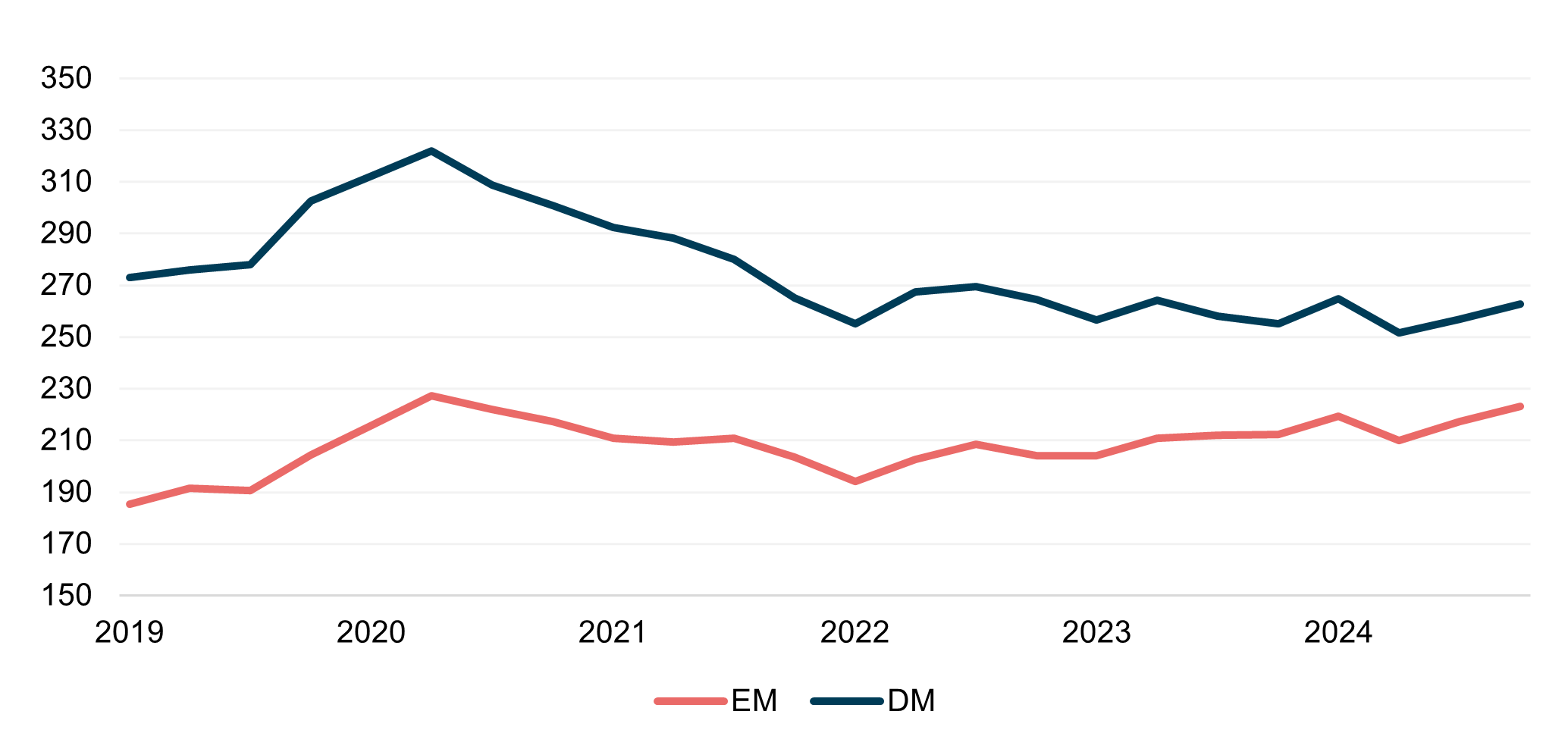
This way of analysing sovereign debt finances is the only way we can reconcile such discrepancies, as EM countries, which, on average, have much less debt than DM countries, trade at much wider premiums to DM ones. When it comes to fiscal headroom, the more sovereign the country is, the more debt it can take, no questions asked.

Exhibit 1: Total Debt to GDP (%)

So, back to Japan. Strictly speaking, Japan’s indebtedness is now less extreme than two years ago: its total debt to GDP is down from 415% to 377%, its primary deficit is even lower (and projected to be in surplus next fiscal year – before the latest news of potentially lowering the consumption tax), but its long-dated sovereign yields have moved 250bp higher in the meantime. It is the rise in long-dated yields that is causing the market to now literally question Japan’s ability to honour its debt (see the latest move in CDS). It is not the level of debt per se. In fact, many EM countries have defaulted at lower debt-to-GDP levels, and even DM countries have not been immune to that.

But is the market ‘wrong’ to price 30yr JGBs at close to 4%? Was the market right to price 30yr JGBs at 0% in 2016? In fact, what was the rationale to have most DM sovereign yields trade below 0% between 2016 and 2020? There wasn’t any structurally sound (and conventional) argument for that – there were plenty of narratives, some good, some really bad. The point again is that, depending on the country, bond math matters less than bond confidence.

The Break in Confidence: Currency First, Then Bonds

But anyway, how did Japan lose the market’s confidence then? Post Covid yields rose across the board as inflation went up and found a higher base globally. What makes Japan particularly different is that its currency also plummeted, weakening 50% against the USD and 100% against the CHF! By almost any fundamental measure, JPY is at its weakest level now since at least the late 1980s. These are EM-level moves; DM currencies are not supposed to weaken like this in such a short period of time. In other words, in the last 2 years, Japan moved sharply away from ‘confidence’ on the spectrum above: despite still being solidly ‘sovereign’, it became less DM and more EM!

And the interesting thing is that this happened when Japan’s fiscal situation actually was improving, not worsening. Why then? So, this is debatable, and there are certainly different arguments, but in my opinion, this was largely because the government endorsed a weak JPY policy to give the inflation genie another push out of the bottle and finally get Japan out of the disinflationary quagmire which had plagued it for three decades. And because the BOJ complied with this by not raising rates and staying in the ‘comfort’ of being behind the curve.

Normally, what happens in such a scenario in EM countries, or any country that is not sovereign, is 1) the country starts having trouble rolling off its external debt (it needs foreign currency for that), and 2) eventually, it may also face troubles rolling off its domestic debt as foreign capital takes off and goes home. All this accelerates the vicious cycle of currency devaluation and possible external debt defaults. Now, Japan 1) has no foreign debt, 2) foreign holders of its domestic debt are a very small percentage of the total, and most importantly, 3) has massive foreign currency at its disposal.

Policy Choice: Reassert the Sovereign 'Confidence Premium'

Unfortunately, being a sovereign with an open capital account also means that domestic accounts can freely respond to this environment by investing money abroad. There are many reasons for that: from not having enough domestic assets (small & open surplus economies, like Norway or Australia), to not having attractively priced assets at home (Japan before Covid, for example). Japan now is peculiar because it has plenty of attractively priced assets at home, but there is a belief that 1) those assets will become even more unattractively priced, so there is no reason to rush, and 2) the currency will keep weakening. In other words, it is a confidence game which can be broken by clear policy signals from the government.

What are those signals? The one that the market has been focusing on the most is on the fiscal side: stabilise the budget and reduce overall net issuance of JGBs. But net issuance has been trending lower recently due to fiscal consolidation efforts, and even though net issuance for the latest fiscal year is higher, net issuance in the long end is still lower – and it is the long end where yields have risen the most. So, fiscal is an issue, but not the main one here.

The signal that can potentially stabilise everything is an explicit policy of a stronger JPY backed by a more hawkish BOJ. If that fails, add incentives to encourage domestic investment to stay home. There is a significant difference between foreign outflows and domestic outflows – the latter have a ‘home bias’ by default. But in the case of the Government Pension Investment Fund (GPIF), for example, there isn’t one, as 50% of its assets are invested abroad (more than for EU or US pension funds, for example). It is much easier to get domestic capital to stay home than to get foreign capital to invest there.

How do we get there? Start with intervention in the currency – Japan has more than enough foreign assets, plus, judging by Bessent’s latest comments, the US will be happy to accommodate. Move Japan up the confidence curve to get capital flowing back to it. I do not buy the view that investors have no reason to put money in a ‘demographically challenged’ country like Japan because of limited domestic opportunities: look at similarly large surplus but much smaller economies which have absolutely no problem attracting capital, like Switzerland and Singapore, for example.

It is a policy choice. Sovereign countries create their own ‘bond vigilantes’ – the latter have power only on paper, so they can be as easily put into oblivion by the right policies.


The views expressed should not be viewed as investment recommendations and are subject to change. 

RELATED INSIGHTS

SIGN UP TO TRIUM TALKS
Trium Talks triangle