Strategist
Share on
No one was talking about an internet bubble before the end of 1998. The years before that were all about making a lot of money in EM, after Mexico devalued in 1994, and losing them all when Asia devalued in 1997, and Russia defaulted in 1998. But then, when the Fed orchestrated a quick succession of 75bps of cuts, we all had to move on to the next big thing, the Internet. That bubble did not burst even after 175bps of Fed hikes, about 2 years later.
I had the privilege to trade through the dotcom bubble, and it taught me something about the theory of reflexivity: what market participants ‘think’ about value can change the way financial assets behave in real life. Soros, himself, apparently, said that when we identify a market bubble, the most logical reaction is not to short it but to join it (the assumption being that we are ‘smart’ enough to identify the bubble early). And I have to say that although joining a bubble may indeed be the profitable reaction function, not shorting one (when you first identify it) is the reasonable one.
Eventually, of course, the dotcom bubble did burst. And I can also tell you that very, very few people made a lot of money in either the way up (and kept the money) or the way down (and counting the money they lost on the way up, shorting it too early). Not even Soros (who, if his chief strategist at that time is to be believed from public comments, actually lost quite a bit of money).
I never played professional tennis (I am that old that I grew up behind the Iron Curtain), but I was just about good enough to get to a US university thanks to my tennis skills. I can tell you that the first thing my college coach told me was that in the big league, 80% of the shots are actually down the middle, because that is the safest option, the best risk-return. You only go for the corners when you really have the advantage. That’s how you trade a bubble.
I think it is likely that all of you have used an AI agent in some form or other this year. They are great, aren’t they? Even if it is not about saving you time from coding, but simply a shortcut to googling, AI empowers and makes you look ‘smart’. “Look smart”…80% of the time, at best[1]. In some cases, AI will give you the wrong output more than 50% of the time. That’s because large language models (LLMs) operate on data correlations, and are fundamentally probabilistic. It is safe to say that most of the time, AI does not make you money. In some cases (see reference below), businesses actually lose money because of AI.
Ok, you say, but these are early days; at some point, AI will become AGI, and then it will ‘make sense’ and probably make a lot of money. Absolutely, but at what cost, and when? For how long can hyperscalers invest $1Tn per year without raising new capital? How much longer can closed-frontier AI models continue to provide free access and subsidise consumers before investors pull the plug on further fundraising for them? When one excludes circular revenue generation, what is the actual return on AI investments (ROAII)? What is the frontier model’s moat that Open/Chinese AI equivalents cannot cross?
Hyperscalers are already running out of free cash and have resorted to issuing new equities (Alphabet and Oracle) and bonds (Alphabet, Oracle, Meta, Amazon, Microsoft). In fact, combined, the hyperscalers have issued more debt YTD than all of last year. When you add the massive IPOs from SpaceX, Anthropic and OpenAI, and all the other announced IPOs, net equity
issuance (so, net of share buybacks) will probably be the largest we have seen since at least 1999[2]. With no new demand on the horizon (‘everyone’ globally is already very overweight US equities), this heralds a big break in the equilibrium.
In a blast from the past, those hyperscalers are using SPVs and circular accounting to report paper revenues and avoid capital destruction. For example, according to McKinsey[3], global data centres built-out will cost $7Tn by 2030: no amount of free cash flow will be able to cover this unprecedented CAPEX, which means even more debt and equity issuance. But that is not the end of it: with a much shorter depreciation cycle, the rate of CAPEX expansion may slow down but will continue to be substantial thereafter.
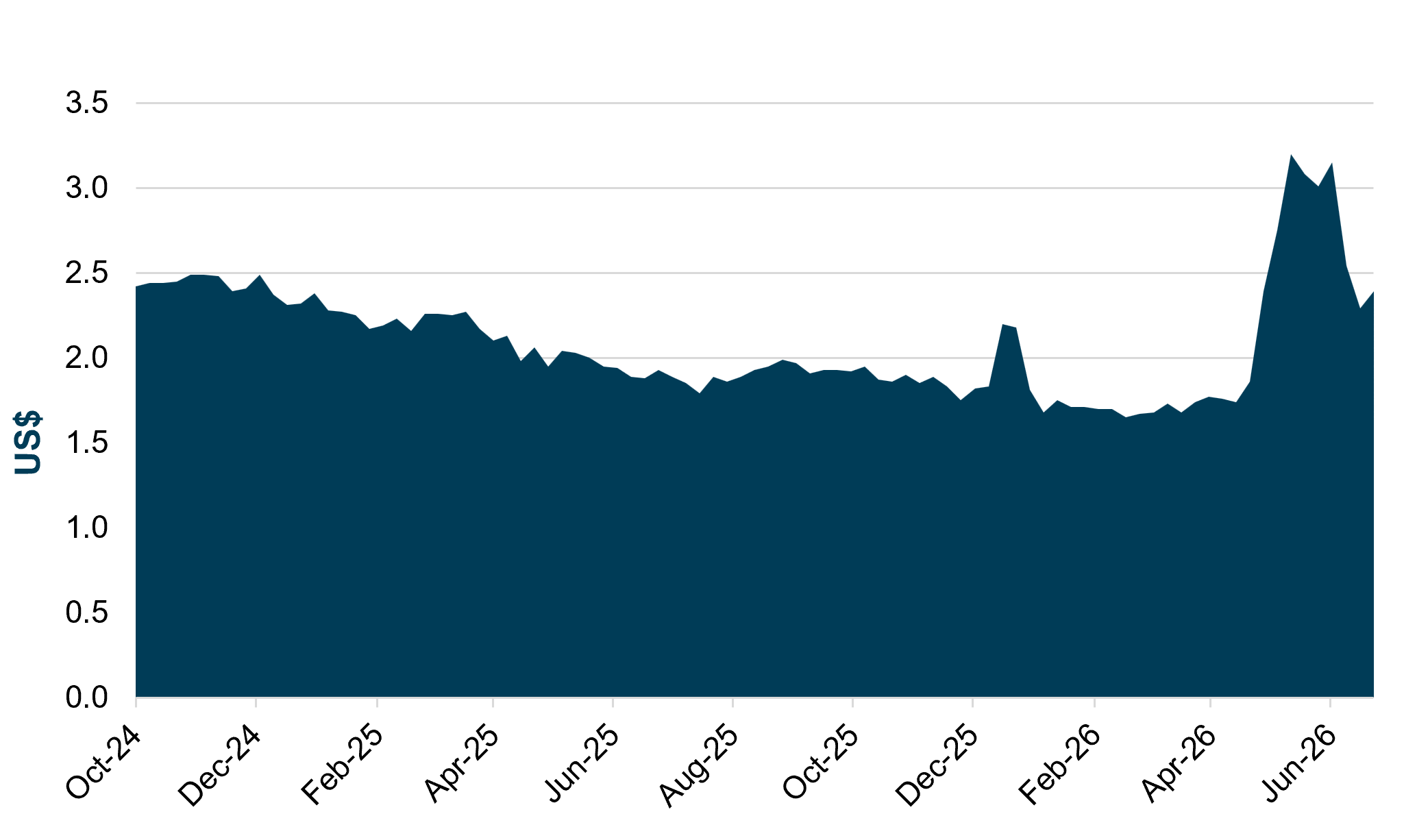
People comparing the internet revolution to the AI one and claiming this time it is different, yes, it is. AI companies are much more about hardware than software, revenue scaling is at a much lower rate, and margins will be much smaller. My view is simply that the hyperscalers will actually start scaling down, not up. Judging by the spot price of Nvidia H100 compute in the on-demand market, that may already have happened.

Exhibit 1: Ornn Compute Price Index (“Brent Crude” of GPU compute)
A benchmark price for renting an H100 GPU, expressed as GPU-hour
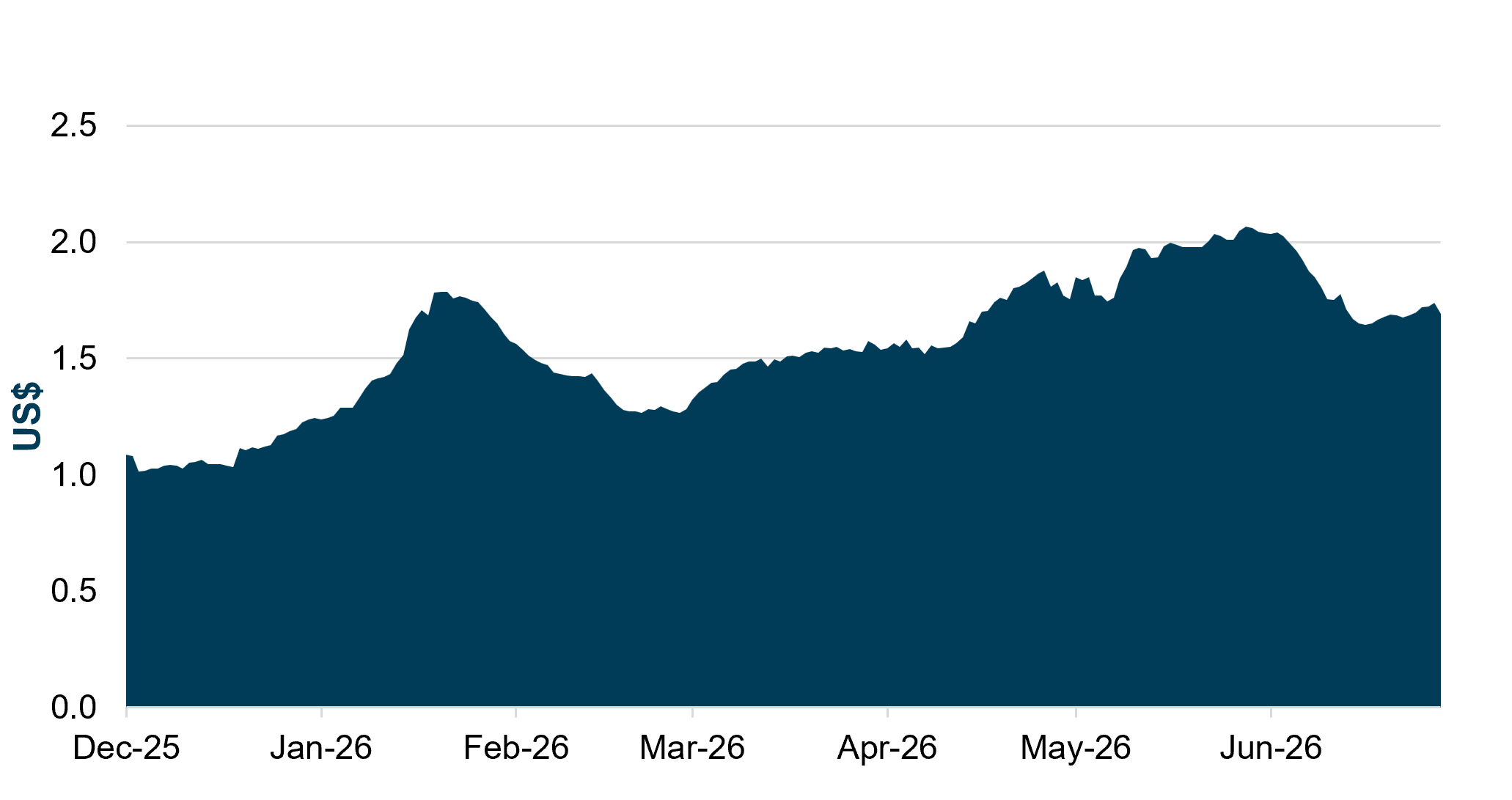
The frontier models are also in a bind: the real economy is pushing back on AI spend[4], and open-source models are closing the proficiency gap (they are already many layers ahead of the closed model in terms of efficiency). But it is not just open-source competition. According to OpenRouter[5], Chinese models are now dominating token usage – and, in fact, all token usage growth since Q3 last year happened on the back of Chinese models. According to Artificial Analysis[6], if we plot all frontier models on a chart showing proficiency (y-axis) vs cost (x-axis), the top left corner will be mostly Chinese models. So, the only way US closed models can compete is to lower the price of tokens, which will take them further away from profitability.
Exhibit 2: LLM Token Expenditure Index (“Brent Crude” of token costs)
Effective blended price of the actively traded LLM market, $ per million tokens
Basically, the whole AI model is kind of stalling because the majority of the revenue generated so far is ‘in-house’, circular, devoid of real/external ‘consumption’. Even the BIS, in its annual review, mentioned this phenomenon, identifying it as a potential risk to the system[7] (page 25, Chart 13C): cross-ownership of AI companies is artificially inflating profits. A good percentage of hyperscalers’ net income in Q1 2026 came from their stakes in frontier models[8].
Where am I going with this is that at some point, either FOMO will wear off and investors will start asking the question, what really ROAII is, or funding costs will rise, which will push companies to rely more on equity capital raising, and then equity investors may require an extra premium to provide that. And because US equity returns are very highly correlated with the AI trade this year (and so is US GDP), equity indices will come off. The question is when?
I mean, there isn’t another more important question in the business of managing money than this one. And that’s why no one knows the answer. So, we never try to focus on that question – it is an impossible question. Are there signs? Sure, but they are not bulletproof. It is a lot more art than science. Can you imagine if tennis players were calculating the speed and accuracy of the ball before each shot? That would be crazy, right? So, it is best to play it ‘in the middle’ and only go for the perfect shot when one senses an opportunity (which often comes when the opponent is ‘exhausted’). We also look for an ‘exhaustion’ and play it safe in the meantime.
[1] Which AI Hallucinates Least? June 2026 Benchmark Rates Data | Suprmind
[2] This will be an absolutely mammoth year for IPOs. Probably
[3] The cost of compute power: A $7 trillion race | McKinsey
[4] AI sticker shock hits corporate America
[6] Comparison of AI Models across Intelligence, Performance, and Price
[7] Annual Economic Report 2026
[8] Half of Google’s and Amazon’s blowout ‘AI profits’ came from Anthropic—not their core business | Fortune
The views expressed should not be viewed as investment recommendations and are subject to change. This material is for informational purposes only and does not constitute investment advice, an offer, or a recommendation.