Co-CEO & Head of Multi-Strategy
Share on
Multi-strategy hedge funds are attracting enormous investor interest. It is easy to see why. Some of the industry’s largest platforms have delivered strong double-digit returns with low correlation to broader markets. In a world where genuine alpha is scarce, that combination is highly prized.
But in conversations, “multi-strategy”, “multi-manager” and “pod shop” are often used interchangeably. They shouldn’t be.
These are structurally different models, with different economics, incentives and investor outcomes. Greater transparency will allow investors to understand precisely which model they are allocating to.
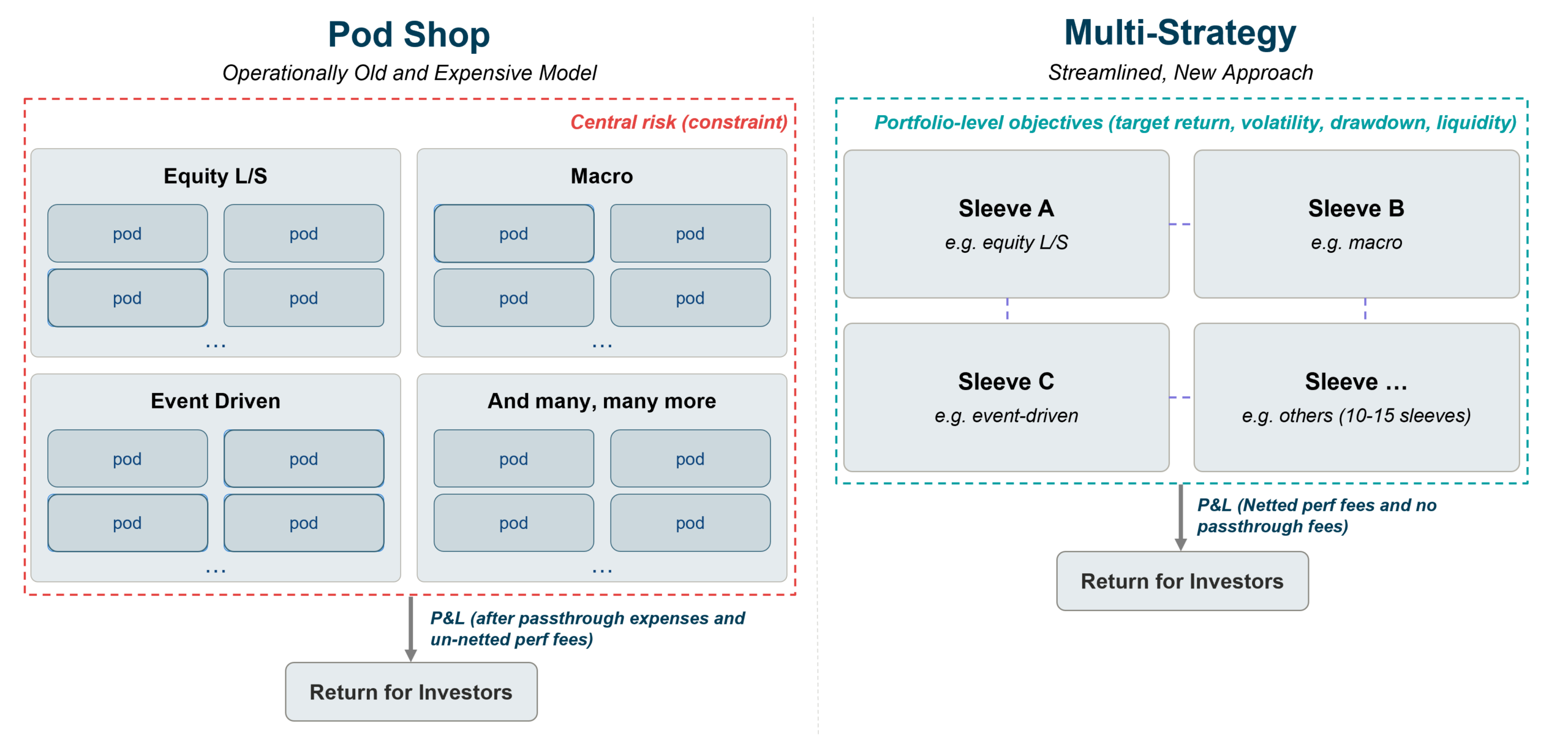
The large pod platforms operate with a broadly consistent architecture. Capital is distributed across dozens, sometimes hundreds, of independent investment teams running tightly controlled books. Risk is centrally managed, allocations are dynamic, and capital is frequently reallocated based on performance.
The model is sophisticated and operationally intensive. It relies on substantial infrastructure: centralised risk systems, technology, data, prime brokerage relationships and a continuous pipeline of investment talent. PM turnover is often high by design, reflecting the competitive nature of the system.
Investment process driven by risk management:
The investment process is often risk-led rather than investment outcome-led. Stop losses are rigidly enforced and will lead to large reductions in allocated capital and to lost jobs, encouraging a “safety-first”, cautious risk-taking approach which can limit return generation opportunities.
The results have often been impressive. But the structure also creates a distinct set of investor considerations:
None of these features are inherently problematic. They are simply characteristics of a specific model which is designed around scale, speed and capital allocation efficiency.
A multi-strategy fund can also be built differently.
At Trium Capital, strategies are combined deliberately to construct a diversified portfolio rather than assembled as independent trading pods competing for internal capital. The distinction is subtle but important.
Portfolio managers run clearly defined sleeves within a broader multi-strategy, while also managing their own single strategy funds with their own track records. The structure is designed to encourage long-term alignment, entrepreneurial ownership and stability of talent. Many portfolio managers invest alongside their clients.
Investment process driven by a patient, return-seeking approach:
The investment approach has a return-seeking mantra, rather than a loss-minimising mantra. Stop loss levels are a signal for a thorough review, not an automatic capital reduction. A more patient, mean-reverting approach is taken. Capital may be added in a drawdown. This creates the opportunity to profit from a rebound, rather than to only participate in 50% of a recovery (if an allocation were to be halved), having suffered the drawdown with 100% of allocated capital.
The economic model differs too:
Liquidity can differ as well. Given the model’s flexibility, better liquidity terms are often more achievable under this approach.
The objective is not to replicate a pod platform in a different wrapper. It is to offer diversified alternative returns through a structure designed around investor alignment, transparency and long-term portfolio construction.
For allocators, the difference matters because structure ultimately shapes outcomes.
Two strategies can both be labelled “multi-strategy” while operating with very different fee models, liquidity frameworks and risk architectures. Those distinctions may matter most during periods of market stress, when alignment, liquidity and portfolio construction become more important than headline returns alone.
Three questions are worth asking any manager describing themselves as multi-strategy:
The answers often reveal more about a strategy than a Sharpe ratio presentation slide.
“Multi-strategy” has become a broad industry label covering very different businesses. Pod platforms and diversified multi-strategy funds can both be highly effective approaches. But they are not interchangeable.
They differ in how capital is allocated, how talent is incentivised, how fees are charged and how investor liquidity is treated.
Both models have strengths. Both can deliver attractive outcomes. But investors should obtain transparency on what sits beneath the label.
Diversification may still be the closest thing investing has to a free lunch. But understanding exactly how that diversification is being delivered, and at what cost, matters just as much.
The views expressed should not be viewed as investment recommendations and are subject to change. This material is for informational purposes only and does not constitute investment advice, an offer, or a recommendation.