See EUA Later: The Populists Are Coming

Tom Roderick

Thomas Roderick

Portfolio Manager

Tom Roderick

Thomas Roderick

Portfolio Manager
Thomas began his career in hedge funds at the start of the global financial crisis, before managing a macro portfolio at Eclectica under Hugh Hendry. Thomas manages a discretionary global macro strategy for Trium. The strategy follows a traditional thematic approach to macro investing, with a focus on identifying and monetising major macroeconomic and geopolitical trends. Tom invests across fixed income, FX, commodities and equities, with a global remit encompassing both developed and liquid emerging markets. Thomas holds an MSci Physics from Imperial College, London.
Trium Epynt Macro
Trium Epynt Macro

Latest Insights

Share on

Europe is changing its attitude towards climate policy, and carbon pricing is in the firing line. Yet EU carbon allowance prices (EUAs) are near the top of their three-year range at around €88, up 40% from the March low. The market thinks the political attack on the scheme (ETS) has been seen off. We strongly disagree.

The upcoming November election in Spain likely pivots European Council arithmetic against the system and in 2027 the maths gets even harder. A Le Pen victory in France next May would sign the death note for the system and a political shift in Poland later in the year would ready the gallows.

Historical precedent suggests that price moves in carbon markets can be extreme, both on the upside (as we have historically tended to find ourselves) as well as on the downside (where we currently have conviction). The ETS is a finely calibrated market of artificial scarcity, held together by political will, and the price tends to infinity or zero. With the political tide now turning against infinity, we believe a range-bound market that is near its highs is vulnerable.

Europe pivots on climate

For voters, carbon pricing is the most visible cost of the energy transition, and the parties gaining ground are targeting it. Italy and Czechia are already pushing to  suspend or dilute the ETS. Spain votes on 29 November, with the PP (who want a brake on carbon market expansion) and Vox (who want to scrap the system entirely) on course for a majority. In Germany the AfD have also called to abolish the ETS. They recently took 43.8% of the vote in Saxony Anhalt and next April’s state elections could end Merz’s chancellorship. France elects a president the same month with the RN in front, while in the European Parliament a right of-centre majority has already weakened other climate initiatives.

Energy prices do the work on their own

With European gas near €100/MWh and power prices at multi-year highs, households and industry already have a strong incentive to cut energy use. Policymakers increasingly see the carbon price as an added cost rather than a tool to drive decarbonisation; this was the argument behind the Italian Czech package of intervention at the recent European Council summit. High gas prices support EUAs in the short run, as utilities switch to coal. But that support is self-defeating: the sharper the energy squeeze, the greater the political pressure to dilute the market/reduce the cost of the carbon ‘tax’. In May 2022, when the Commission proposed selling allowances from the reserve to ease the energy crisis, EUAs fell 15% in four days.

Dilution has already started

  • The ETS scheme to extend the carbon market to cover heather and road fuel has been delayed from 2027 to 2028, and the Czechs now want 2030. 
  • The Commission’s July review slows the speed at which the annual cap on emissions tightens from 4.4% to 3.7% (for 2031-35), and to 1.7% (from 2036). It also extends the free allocation of allowances to 2040, pushes the carbon border (CBAM) sector phase-out back to 2038, and adds 400m allowances via an Investment Booster to support decarbonisation projects.
  • In September the Council backed both the issuance of 121m extra free allowances for 2026-30 and the suspension of the cancellation of allowances held in the Market Stability Reserve (MSR), the mechanism which adjusts the supply of allowances to keep the market from swinging too far in either direction, until the end of 2030.

The market thinks the worst is over

EUAs fell 31% between January and March on Chancellor Merz’s call to revise or postpone the ETS and Italy’s demand to suspend it, then rallied back as the outcome was to compromise and ease the rules. At €88 the market is pricing the Commission text as the landing zone. We think that is wrong: each concession makes the next one easier.

A race against the calendar

Brussels knows the ground is shifting, which is why it is rushing to find a compromise: the Council are convening to agree a position on 11 December, with a vote in Parliament in mid-December and a final deal by the end of March 2027 (about eight months from proposal to deal, against 21 months for the 2023 reform). Significantly, climate guru Peter Liese (EPP), who is Parliament’s lead negotiator on the ETS, has proposed an even softer, earlier, cap than the Commission. Delay does not remove the desire to loosen. It hands the decision to a less supportive Council.

Spain and France tip the Council

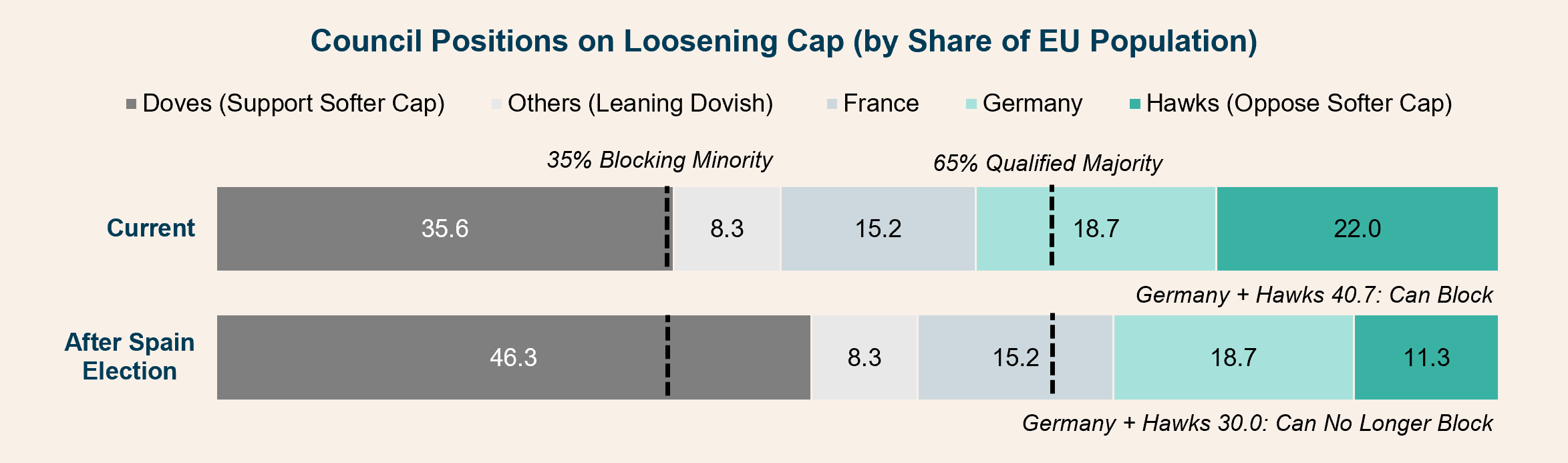
Today Germany, Spain, the Netherlands, the Nordics, Portugal and Luxembourg (the ‘hawks’) together represent 41% of the EU population; enough to block the loosening of the cap on emissions. Polls give the PP and Vox about 200 of 350 seats in Spain. Once that government is seated in January, the hawk’s share falls to 30%, and they lose their blocking minority. France already backs a softer cap; an RN presidency from May 2027 adds to the push for more material change. With France, and the other member states that are leaning dovish, the ‘doves’ reach 20 states and 70%, a qualified majority, even without Germany. Then there is Poland, with its heavy industrial base, much the same as Czechia, which goes to the polls in late 2027. Tusk the consensus Europhile currently leads in Poland, but it looks increasingly likely his reign will end, providing a further blow against Eurocentric policy and the ETS. The next year is going see sustained and growing political pressure against the previously bulletproof ETS.

Exhibit 1: Council Positions on Loosening Cap (by Share of EU Population)

Source: Veyt position tracker (8 Oct) and the 12 Oct ministers' meeting; post-election positions are our projections. A qualified majority needs 15 states and 65%; a blocking minority needs four states and more than 35%.

Where gradual dilution ends

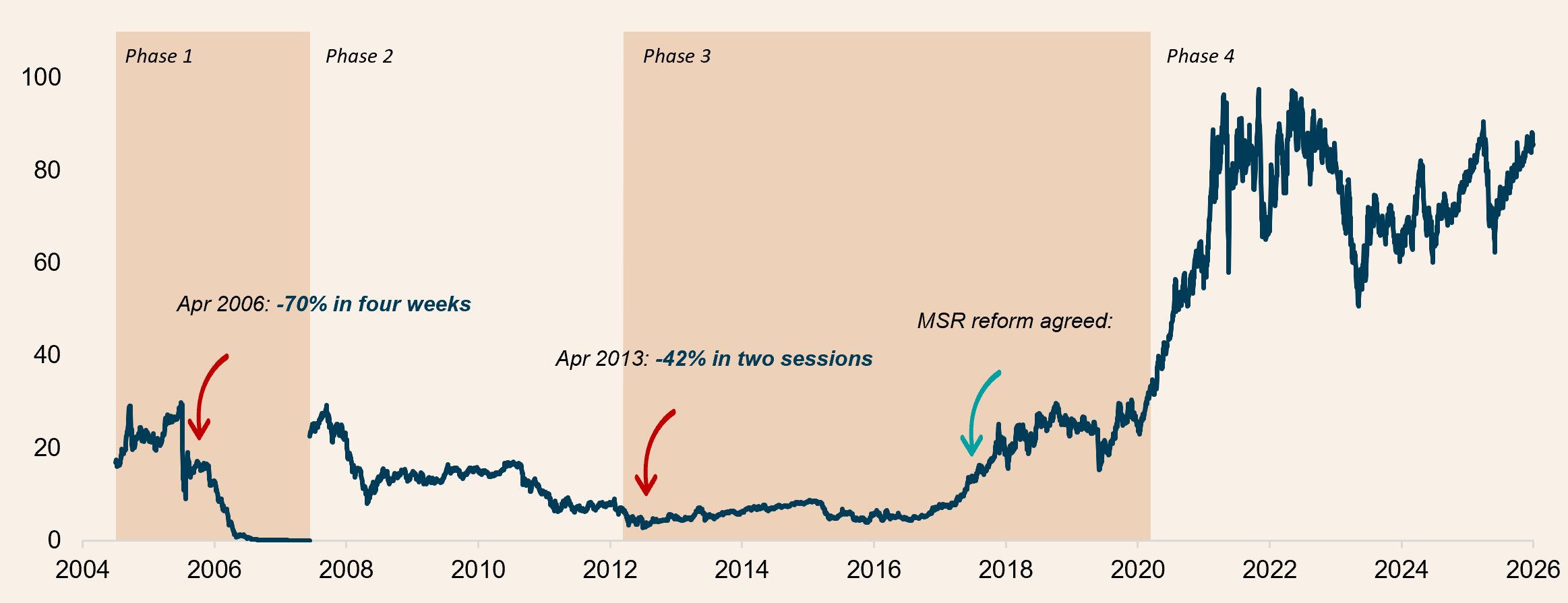
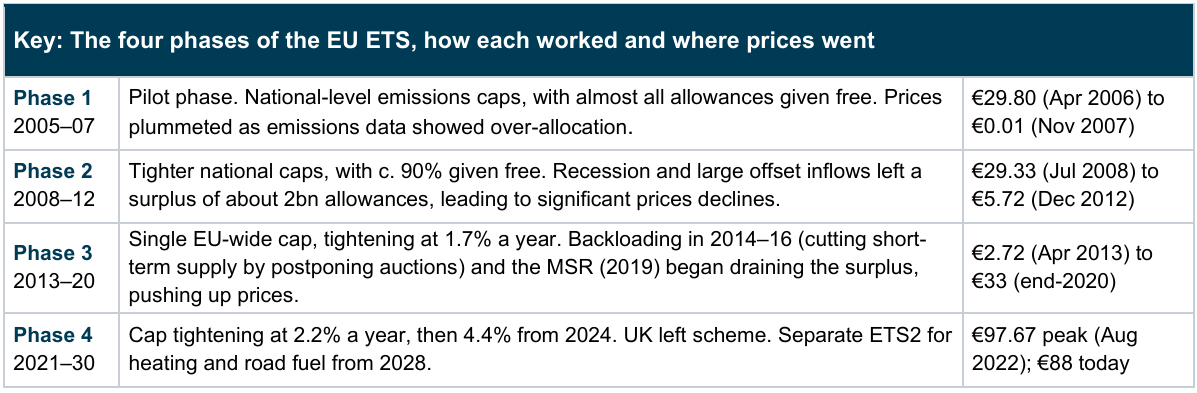
The price must reflect the risk of a glut driving it towards zero. This may sound extreme, but it has happened twice before. In the first official phase of the ETS, EUAs peaked at €29.80 in April 2006, before falling 70% in under four weeks when the first verified emissions data showed over-allocation and were worth €0.01 by November 2007 because they could not be carried into the second phase. In Phase 2, recession and offset inflows (credits bought from developing countries) built a surplus of around 2bn allowances, and prices fell from €29.33 in July 2008 to €2.72 in April 2013. The low came the day after Parliament rejected the postponement of auctions to support prices, with the centre-right EPP decisive: one vote took 42% off the price in two sessions. Scarcity only returned once the MSR reform was agreed, lifting prices from €8 to €25 in 2018. Today that fixing plaster is being torn off: cancellation is being suspended, the Commission proposes halving the intake rate (of allowances that are withheld and placed into the MSR) from 2028, and Italy and Czechia want allowances released.

Exhibit 2: EU Carbon Price (EUR)

EUA front month futures. Phase 1 allowances could not be carried into Phase 2, so the series breaks in April 2008.

UK linkage does not change this

Linking with the UK carbon market, expected to be announced at the 20 November EU-UK summit, is a win for the scheme’s credibility but adds only about 6% to the combined market. UKAs currently trade about €10 below EUAs, so the market sees the UK as the looser system; if so, linking imports slack rather than scarcity. Either way the effect is small, and the link is unlikely to go live before 2029.

Where will carbon prices go next

The political risk has shifted on EUAs from supporting long positions to preventing EUAs from getting to a new high. EUAs have never traded above €100 and we see no path for them to do so in this political climate. We believe the magnitude of the political changes coming mean that this, rather than colder weather or further gas restrictions this winter, will be the price driver. It is an artificial system in a period of extreme stress, and politicians will do whatever it takes to get carbon prices down.

The views expressed should not be viewed as investment recommendations and are subject to change. This material is for informational purposes only and does not constitute investment advice, an offer, or a recommendation.

RELATED INSIGHTS

SIGN UP TO TRIUM TALKS
Trium Talks triangle